Fire TV Stick subtitles not showing: how to fix your subtitle file
Updated October 28, 2026
A Fire TV Stick plays Prime Video and other streaming apps with their own subtitles, but it has no built-in player for your own video files. To watch a film with a subtitle file you downloaded, you need an app such as VLC (free in the Amazon Appstore) or a media server app such as Plex or Jellyfin. Those apps read the subtitle, so they decide whether it shows.
This guide is about your own files. For subtitles in Prime Video, Netflix and other streaming apps, press the Menu (☰) button during playback and pick a subtitle track there.
1. Get the video and subtitle onto the Fire TV
The Fire TV Stick has only one port, for power, so the usual "copy to a USB stick" step needs extra hardware:
- USB drive through an OTG adapter. A powered OTG cable (a Y-cable with the Fire TV’s power adapter plugged into it) lets many models read a USB drive. Support depends on the model: the first-generation Fire TV Stick doesn’t play from external drives at all, and the Fire TV Cube handles drives better than the sticks. If the Fire TV restarts with a drive attached, it is short of power; use the original power adapter or a powered USB hub.
- Over the network. VLC can open a shared folder on your computer (SMB). Plex and Jellyfin stream from a server running on your computer.
Whichever way you choose, the subtitle file has to travel with the video: copy both to the same folder.
2. Same name, same folder
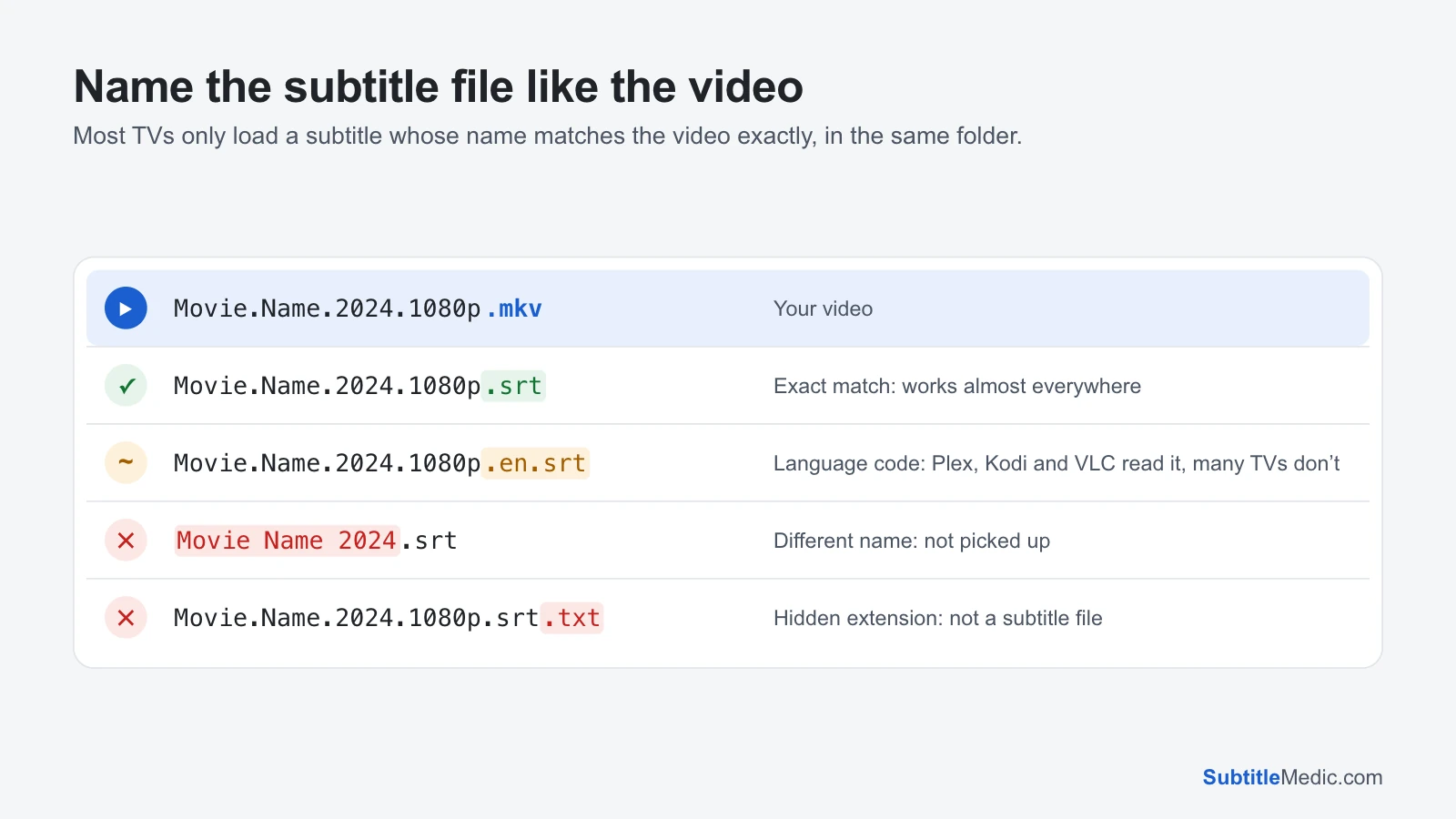
VLC loads a subtitle by itself when it sits in the same folder as the video and has the same name, only with .srt at the end:
 Open full size (new tab)
On Windows, turn on View → Show → File name extensions before renaming. Windows hides the real ending by default, so Movie.srt may actually be Movie.srt.txt, which no player opens.
For Plex and Jellyfin, add a language code: Movie (2024).en.srt. The server uses it to label the track, then refresh the library so it sees the new file.
3. Turn the subtitle on in the app
Finding the file isn’t always enough; some apps start with subtitles off.
- VLC: during playback open the subtitle menu and choose the track. If it isn’t listed, use the option there to select a subtitle file and browse to it. Loading it by hand also tells you the file itself is fine and only its name or place is wrong.
- Plex and Jellyfin: open the playback settings and pick the subtitle track. If the track is missing, the server hasn’t found the file: check its name and refresh the library.
When a video is played over an SMB share, VLC sometimes skips a matching subtitle that it loads without trouble from a USB drive. Load it by hand in that case.
4. The Fire TV’s own subtitle setting
Fire TV has system subtitle settings under Settings → Accessibility, listed as Subtitles or Closed Captioning depending on the software version. They switch captions on and set the text size, colour and background.
These settings only reach apps that are built to follow them. Prime Video does; VLC, Plex and many other apps use their own subtitle menu and ignore them. If the text looks wrong in one of those apps, change the style in the app, not in the Fire TV settings.
5. A format the app doesn’t read
VLC reads almost every text subtitle format. Plex and Jellyfin are pickier when they stream to a Fire TV:
- .ass / .ssa (anime, fansubs): the server may burn the text into the picture, which needs a fast server and can stutter. ASS to SRT gives a plain file the Fire TV draws itself.
- .vtt (web subtitles): VTT to SRT if an app ignores it.
- Image subtitles from Blu-rays (PGS, .sup) are pictures, not text, and are usually burned in. Use a text subtitle for the same film when you can.
Subtitles inside an .mkv that an app skips can be saved as a separate .srt with Extract Subtitles from MKV.
6. Broken letters
If the text shows é, Ä‘, question marks or boxes instead of accented letters, the subtitle was saved in an old regional encoding, not UTF-8. VLC has a subtitle text encoding option, but you’d have to set it again for every file. Fix Subtitle Encoding detects the encoding, shows the repaired text and saves the file as UTF-8 once, so it reads correctly in every app.
If tags such as <font color="#ffff00"> or {\an8} appear on screen, Remove Formatting from Subtitles strips them out.
7. The subtitles are early or late
When the lines show but don’t match the voices, the file was made for a different release of the film. VLC can delay the subtitles during playback, but on a remote that is slow and the delay is lost next time. Fix the file instead:
- Subtitle Player: play the video with the subtitle in your browser, nudge it until it matches, and download the synced file.
- Change Subtitle Frame Rate: when the first lines match but the gap grows as the film goes on.
How to fix subtitles out of sync explains how to tell the two problems apart.
Quick checklist
- The video plays in VLC, Plex or Jellyfin, not a streaming app.
- The USB drive works on your model, with enough power, or the files come over the network.
- The subtitle has the same name as the video and is in the same folder.
- Subtitles are switched on in the app’s own menu.
- The file is SRT, saved as UTF-8.
Using a different device? See Android TV and Google TV subtitles not showing, Chromecast subtitles not showing and Roku subtitles not showing.